This is a blog chronicling a four year period from 2006-2009
during which I underwent what is commonly referred to as a midlife crisis. At that time I had been in Japan for 10 years
continuously, and for 15 years of the past 19.
Since 1988 I had been – and continue to be – a teacher of English as a
Second Language, initially at the secondary level and later in colleges and
universities.
In 2006 I was 45 years old.
I decided to leave my jobs to study thangka painting in Kathmandu. I did this for a total of one year over three
visits spanning three years. The details
are in the blog. Along the way I did a
lot of other interesting stuff – I attended my first Vipassana course (I just
finished my fifth a couple of weeks ago), visited the four major Buddhist
pilgrimage sites of India and Nepal (plus a few more), met a tulku, took refuge
from the Karmapa, walked a 1200km pilgrimage in Japan, took lay ordination in
Soto Zen, and jumped off a 165 meter bridge with rubber band tied to my ankle. The adventure took a different turn in 2009
when I moved to the Arabian Peninsula to teach English at a women’s college (which is where I remain as of this writing).
As this is a blog, the contents are displayed in reverse
chronological order. If you wish to read
chronologically, perhaps the easiest way is to scroll down to Blog Archive
(located just after Fukuoka Sky in the side bar at right), click on 2007, and then
on January. All the posts from that
month will be displayed on one page, with the first post of that month
appearing at the bottom.
There is also a companion blog about my Shikoku
pilgrimage. You can find it here, or
through a link in the side bar, just after About the Author.
Looking back I’m surprised at how much I did during those
four years and how those activities gave my life a new trajectory. Should you be contemplating a similarly
radical departure, I hope my story provides inspiration and convinces you that
your wild idea may be possible. I also
hope you have an equally loving and supportive spouse.
I ran across this photo while searching for something else and was impressed by the quality of the photo itself, as well as the complete absence of buildings surrounding the gompa. Those who have been there recently know the area is now entirely developed.
The photo and accompanying story of the gompa's founding is here.
Early this year when I was painting in Kathmandu a French film maker came to art school for a few days to shoot for a documentary. This evening I received a note from Yoji in Belgium that he saw me on TV and that the film is available for viewing online for one week only here.
I feel somewhat melancholy seeing my old classmates, the temple, the school, and the neighborhood. Those were beautiful days.
Soon after publishing my wistful rainy morning post, a breeze from long ago blew through my in-box. It was the organizer of this year's 30th high school graduation reunion with an update on this month's event.
Anyone who went to an urban US high school in the late 70's remembers three groups of students: geeks, jocks, and stoners. I was never in the second group and might have ended up in the first if I hadn't first fallen in with the latter. Needless to say, I don't have fond memories of high school because, well, I have few memories at all.
Included in the email update was a request from the DJ who will be working the reunion party for a class song. I would imagine that the people organizing this event belong to either or both of the first two groups of students. I can't imagine many in the third group really caring very much one way or the other. And I would expect this organizing person to choose something upbeat and positive, a kind of Teach-the-World-to-Sing type song.
What was suggested instead was the stoner anthem.
If I leave here tomorrow Would you still remember me? For I must be travelling on, now, 'Cause there's too many places I've got to see. But, if I stayed here with you, girl, Things just couldn't be the same. 'Cause I'm as free as a bird now, And this bird you can not change. Lord knows, I can't change.
Oh, the sweet, delicious irony. The music of the group of kids who were always on the out is now the anthem for the entire class, geek and jocks alike. Now I wish I were going so I could hold up my lighter one more time. "Oh won't you fly high, oh Freebird!"
The timing also seemed perfect, with lyrics suited for the occasion of leaving, of traveling on. I'm as free as a bird now.
Strangely enough, I saw Lynyrd Skynyrd at the Miami Sportatorium on the opening night of the Street Survivor's tour in October 1977 (about which I also don't remember much). Five days later the plane carrying the band crashed, killing three members.
. This morning I took my coffee on the veranda and watched the dark clouds roll over. The cicadas were chirping. A crane flew past, angling toward the river. A man came out to the park with his Shiba for the morning fag and constitutional.
I was feeling a bit melancholy. Twelve years of my life in this city, in this apartment, and looking out at this view. One quarter of my life. And after Friday, I won't be looking at it ever again.
And then I noticed, just over to the north, a small hint of a rainbow.
Ten minutes later and it was pouring down rain.
My bags are packed. I shipped the biggest one to the airport Monday. I also posted my last 30kg box of stuff to RAK, the last one to go.
All that remains is to get on the airplane Friday.
. The Kyoto Vipassana Center was a veritable hotel.
There was soap in the bathroom, detergent for washing clothes (by hand in a bucket), a spinner to save you the effort of hand wringing wet clothes, screens on all the windows, hot water on demand, clean futons, immaculate wood floors, a wide assortment of condiments (such as pickles, teas and sweeteners), insect repellent, salve for bug bites, a large container of medicines in the kitchen, complimentary earplugs in case you were bunking with a snorer, and fans in all the rooms. The only thing not included were sheets, which oddly enough were one of the few provisions at Bodhgaya and Sarnath, the two India centers I visited in 2007 and 2008. There we had nothing more than a bed, cold water, buckets, and mosquitoes (even in December).
Kitchen in the background, attached to dining hall left (not visible in this photo)
Fortunately, few of the latter were buzzing about Kyoto, even in the midst of summer. We did, though, seem to have more than a fair share of spiders and cockroaches, neither of which were a particular bother, except for the cobwebs that occasionally came in contact with my face. Pleh, pleh . . .
The Kyoto center was christened Dhamma Bhanu (Dhamma Light) by Goenkaji himself back around 1989 when the master paid a visit and taught a course or two himself. Today you'd hardly guess that the facilities are 20 years old. It seems a good amount of love and attention has been lavished on their maintenance.
Stairs at left from the Dhamma Hall / Residential Building. Building at right toilet/shower block, building left dining hall and kitchen.
Toilet/shower block, space for hanging laundry
Like most Japanese buildings or compounds, those of Dhamma Bhanu are rather compact. The residential quarters and Dhamma hall are in the same building. My room was only 5-6 meters from where I sat each day for meditation. Even those housed furthest from the hall are no more than 20-30 meters away. Once you leave the residential building, its only a dozen paces to the bath/toilet block or to the dining hall.
The Dhamma Hall is in the center on the second floor; left wing is female residence, right wing male. The garden was available for walking to female students.
To the right of the above photo was this patch of grass and clover, used for overflow and as walking space for male students.
The center sits in a valley in northern Kyoto prefecture, a quiet pocket of Japan through which passes one narrow road used each day by perhaps a dozen or so drivers. When you're sitting you might also notice a small plane passing overhead a couple of times a day. Otherwise there are few audible intrusions of the surrounding society – no school bells, no trucks blaring advertisements, no construction, no kids playing ball. Just the relaxing chirping of crickets, cicadas, and birds, as well as the gurgling of a small stream running around the perimeter of the center's property, bounded by low mountains (or high hills), a lush green in the midst of the summer season.
At this time of year typical daytime temperatures are uncomfortably warm. A center volunteer noted that the heat often makes meditation uncomfortable. We were quite fortunate, though, to have rain every day of the ten our group was in residence. The sun came out for a couple of hours on two or three days, but for the remainder it was overcast, windy, and wet. I didn't hear anyone using electric fans in the evening. It was a bit too chilly for that.
The Dhamma Hall on last day clean-up.
I understand installation of air conditioning in the Dhamma Hall is under discussion. Perhaps it will be added soon to make life more bearable for those city seekers brave enough to sit quietly for ten days with few of the comforts to which they are accustomed. If you happen to have difficulty with mobility, though, you will not be able to meditate at the Kyoto center. The Dhamma Hall is located on the second floor, up a flight of 16 steep steps, and if you also happen to be male you'll have to climb another set of steps to get to your meals. New students can expect to share a room with anywhere from three to six others, with little more than a futon-size private space. Old students may also have to share living quarters if they attend during one of the center's peak periods (which coincide with the Japanese vacation calendar – New Year's, Golden Week, and Obon).
The male dining hall
As one might expect for a center in Japan staffed by Japanese volunteers, the food was typical Japanese fare. Mid-day meals included oden, pasta with tomato-based vegetable sauce, udon, a one-pot dish of mixed veggies boiled in a light soy sauce, chilled tofu with green veggies, and on the last day, Japanese curry. Whatever was left over from lunch was recycled the next morning, along with fresh bread, butter, jam, and copious amounts of fruit, which in summer included bananas, oranges, grapefruits, apples, and plums. The evening meal for new students was fruit, for old students tea. Altogether the food was healthy and the amount adequate, but taste and presentation hardly remarkable.
Information displays Day 10
One thing I greatly appreciated at the Kyoto center (that I did not find at either of the Indian centers I visited) was the management's willingness to share financial information. On the last day of the course when silence is lifted and donations accepted, a number of placards were erected in front of the dining hall with information on center activities and volunteer opportunities. Included in this presentation was a chart of the center's income and expenses. If you were perhaps wondering about the size of an appropriate donation, you could find that the average daily expense per student is just over 2000yen.
Center income and expenses
This may seem high in comparison to India, but where in Japan can you get two meals a day, a clean bed, and all the other amenities – plus absolute silence and the chance to meditate? Just make sure you bring cash. Credit card donations are not accepted.
Dhamma Bhanu is a fine facility for sitting Vipassana. I'll be leaving soon to take a job in the Middle East, but should I ever be back this way, and have the opportunity, I would be very pleased to sit another 10-day course in Kyoto.
. My flight details came in yesterday. I was initially scheduled to fly Asiana to Seoul and then Emirates to Dubai, but I put in a friendly request and will now be flying ANA to Kansai (Osaka) and then on to Dubai by Emirates. This works out better as I can take advantage of Emirates' higher baggage allowance (which would have been impossible flying Asiana).
If all goes according to plan, I'll be leaving next Friday evening, August 14, arriving Dubai around 05:00 of the 15th.
. Back in April we attended an exhibit of Tibetan cultural relics organized by the Chinese government. It appears someone in Japan has at last decided to organize and do something to educate the media and the public. Good for them.
I arrived in Fukuoka last night after a 10-day meditation retreat in Kyoto and a couple of days visiting with the in-laws. I will write more later about the Kyoto experience, but for now wanted to let you have a look at my niece.
We still had some trouble communicating, as we have had since the last time we met. Besides her mother and grandmother, Shiori is wary of contact with anyone else, including aunt Mutsumi and uncle Jeff. When you start to get close, she begins breathing hard and whining, and if you come too close may begin crying.
If you approach while her attention is diverted, though, she has no time to anticipate and react. In this way I was able on our last night to carry her through downtown Sannomiya with only a small initial whine.
If you were with me back at the beginning of the year when I was working on my first thangka, you might remember pictures like this.
On the left is my painting. On the right is my classmate Tsering, my friend and confidant who, as you can see, was working on a painting of Tara.
Just yesterday she sent me some photos of the completed work, which I thought I'd share with you here. This is, as far as I am aware, Tsering's second thangka. We look forward to many more.
Click this link for a slideshow of photos from our new home. (Clicking on the photo will take you to the page for this photo only and not the slideshow.)
Yesterday Mutsumi had a couple hours of work in Nagasaki and as I haven't been in a while and as I'm unemployed and mostly ready to move to the UAE, we decided to make the trip together and rode out together on the 07:00 bus. While Mustumi was working I wandered around through Daionji, a 17th century temple which sits at the bottom of a mountain that we would later that day climb by taxi.
I didn't realize until I viewed the photo on the computer that the gate is fashioned in the shape of the Buddha's feet.
The sound of summer. The first cicada I've seen this season .
After meeting up with Mutsumi for lunch in Chinatown, we went to visit her grandfather Tomonaga's grave, which has a lovely view over the bay. Mutsumi swept and layed fresh flowers, and then we walked down the mountain, which seemed to be covered with nothing but graves, only to come out in - Daimonji!
The email for which I have been waiting has arrived and I can now announce that I will next month be moving to Ras Al Khaimah, one of the seven Emirates that make up the United Arab Emirates. Mutsumi will be joining me next year after completing her contract with her present employer.
I will be teaching at the women's Higher College of Technologies, about which you can learn a little more on their website here. If you want to know more about the Higher Colleges system, have a look here.
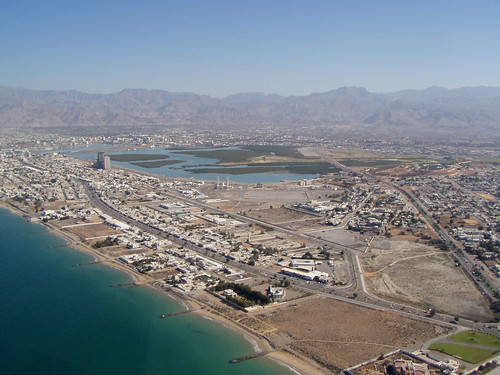
Ras Al Khaimah is right at the northern tip of the the UAE. You may notice a mountain range, which makes the geography a little more interesting than sand dunes. Dubai is quite close by, only a 60-90 minute drive. And if the Iranians ever decide to shut down the Strait of Hormuz, as they've threatened from time to time, we'll have a front row seat.
I'll post more later. For now, here are a couple of RAK promo videos.
I don't know who Moeka Hiraoko is. Perhaps she's a student of Parissa Haghirian, an Austrian professor of management at Tokyo's Sophia University on whose website Moeka's essay is posted. Google didn't return much on Moeka except a Facebook entry, and as her essay is copyright 2009, and is about her experience studying in the United States, I guess she may even still be a student.
Who she is, though, is not so important. It's what she has written about her experience in America that you may find interesting. A typical middle class Japanese girl who went to San Diego to study English, she took an immediate disliking to her Swiss classmate Maria, who seemed to embody the stereotypical image of the selfish westerner.
For example, her English was much better than mine and when I didn’t understand what she said, she showed her irritation very clearly. We both loved shopping so we went to malls almost everyday after school, but she didn’t care how long she made me wait, and didn’t wait for me when I took time. Also, our host family had a nine year old daughter who was cute and lively, but Maria thought that she was sometimes annoying. When she asked us if we would like to do something with her, Maria often said no, even though the family was taking care of us. All these actions are considered very rude in Japan, and I had never met someone like her before. So I started to become offended by her behavior after spending a week with her.
However, what surprised me a lot was that another girl, whose name was Ina and also came from Switzerland, said that Maria was very cool. I could not believe it at first because I thought that she was harsh and unpleasant. I asked Ina why she thought that Maria was cool. She told me that a girl like Maria, who always expresses her opinion without hesitation and does whatever she wants with confidence, is considered a cool person in Switzerland. I am not sure if this is actually the standard of cool girls in Switzerland because I have never asked anyone else from thereabout it. However, for me at the time, with barely any experience outside Tokyo, it was very surprising that someone would think about Maria like that. I had heard that Western people were not at all like Japanese people, but it was the first time that I had actually experienced it.
Moeka then does what for most people would be difficult, for many impossible. She sets aside her native inclinations to adopt Maria's behavior in order to find out from the inside what it's like to live as the other. You can read more about her experience here. Don't worry, it's not a long essay.
What struck me most while reading it was how well I could relate to Moeka's feelings. I suppose 17 years living among Japanese has made me more like them than I perhaps imagined. Which is really not a bad thing at all.
Except when you have to deal with opinionated westerners.
While going through a box of books I found a 1999 copy of the Kyoto Journal, a rather special issue with articles on Donald Ritchie, homelessness in Kobe, and Princess Mononoke. But what caught my attention was a long essay titled "Buddhism and Poverty," whose author argues that the developed world's poverty reduction efforts, carried out through such organizations as the World Bank, the UN, and numerous NGOs, are largely ineffective because they proceed from ignorance of the human condition.
We are at the most profound level, David R Loy believes, trapped by dualistic thinking. Developed socieities exist only in relation to undeveloped. Success to failure. Wealth to poverty. Neither can exist without the other.
The poverty of others is ... necessary because it is the benchmark by which we measure our own achievements. Unless there are losers, we cannot feel like winners. Unless the undeveloped are unhappy about their lot, we are unable to feel happy about what we have, unable to rationalize the things we have had to put up with in order to get there, unable to excuse the negative consequences of our economic development. In this fashion too what we perceive as a poverty problem is due to the tinted lenses of our wealth/poverty spectacles — and what is colored most of all by those lenses is our own self-appearance. To live in a commodified world is to recognise that we too are commodified, and as we know the value of commodities is determined by price comparison. Who earns more, you or me? We can rarely ask this question because it cuts too deeply, to the source of our self-esteem. This also applies collectively, to the way we see others.
The rest of the article is worth reading and can be found here, though you may have to enlarge the font in your browser to make for comfortable reading.
Follow the heart to happiness. Follow the herd to dissatisfaction.
This is what researchers at the University of Rochester claim to have found in a small study examining intrinsic and external forms of motivation in 147 recent university graduates. Students that focused on achieving personal goals self-reported as happier than those who focused on socially defined goals such as wealth, status, or fame.
While this study doesn't prove anything, it does suggest something we all feel, that chasing the dreams of others is often frustrating and unfulfilling. A similar study on older subjects, people with a lifetime of experience doing both, might show something else entirely, that over the course of a lifetime, even personal achievements are trivial concerns. As Dolly Madison said at the age of 80 to a young niece:
"When you don't have obsessions, when you don't have hang ups, when you don't have inhibitions, when you are not afraid that you will be breaking certain rules, when you are not afraid that you will not fulfill somebody's expectations - what more enlightenment do you want?" - Dzongsar Khyentse Rinpoche
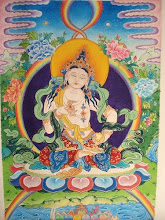
Thangka Artist: Ngakma Pema Zangmo
A-yé Khandro
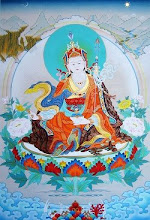
Artist: Anya Langmead
Prajnaparamita
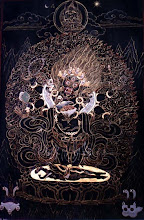
Thangka Artist: Sashi Kumar
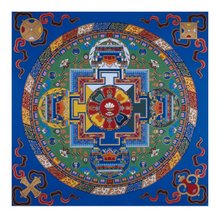
Vajrayogini Mandala
About the Author
In search of a new path, a 40-something with no previous art training heads to Kathmandu to study thangka at a Tibetan art school. Along the way he meets people, reads books, meditates, and writes about it here. Started in 2007, this chapter closes in 2009 when the author takes a teaching assignment in the UAE.
My Shikoku Pilgrimage Blog
Beginning is End
The end of building is ruin. The end of meeting is parting. The end of accumulation is dispersal. The end of birth is death. - Ken McLeod
"Twenty years from now, you will be more disappointed by the things that you didn't do than by the ones you did do. So throw off the bowlines. Sail away from the safe harbor. Catch the trade winds in your sails. Explore. Dream. Discover." - Mark Twain





 Posts
Posts