The email for which I have been waiting has arrived and I can now announce that I will next month be moving to Ras Al Khaimah, one of the seven Emirates that make up the United Arab Emirates. Mutsumi will be joining me next year after completing her contract with her present employer.
I will be teaching at the women's Higher College of Technologies, about which you can learn a little more on their website here. If you want to know more about the Higher Colleges system, have a look here.
Ras Al Khaimah is right at the northern tip of the the UAE. You may notice a mountain range, which makes the geography a little more interesting than sand dunes. Dubai is quite close by, only a 60-90 minute drive. And if the Iranians ever decide to shut down the Strait of Hormuz, as they've threatened from time to time, we'll have a front row seat.
I'll post more later. For now, here are a couple of RAK promo videos.
I don't know who Moeka Hiraoko is. Perhaps she's a student of Parissa Haghirian, an Austrian professor of management at Tokyo's Sophia University on whose website Moeka's essay is posted. Google didn't return much on Moeka except a Facebook entry, and as her essay is copyright 2009, and is about her experience studying in the United States, I guess she may even still be a student.
Who she is, though, is not so important. It's what she has written about her experience in America that you may find interesting. A typical middle class Japanese girl who went to San Diego to study English, she took an immediate disliking to her Swiss classmate Maria, who seemed to embody the stereotypical image of the selfish westerner.
For example, her English was much better than mine and when I didn’t understand what she said, she showed her irritation very clearly. We both loved shopping so we went to malls almost everyday after school, but she didn’t care how long she made me wait, and didn’t wait for me when I took time. Also, our host family had a nine year old daughter who was cute and lively, but Maria thought that she was sometimes annoying. When she asked us if we would like to do something with her, Maria often said no, even though the family was taking care of us. All these actions are considered very rude in Japan, and I had never met someone like her before. So I started to become offended by her behavior after spending a week with her.
However, what surprised me a lot was that another girl, whose name was Ina and also came from Switzerland, said that Maria was very cool. I could not believe it at first because I thought that she was harsh and unpleasant. I asked Ina why she thought that Maria was cool. She told me that a girl like Maria, who always expresses her opinion without hesitation and does whatever she wants with confidence, is considered a cool person in Switzerland. I am not sure if this is actually the standard of cool girls in Switzerland because I have never asked anyone else from thereabout it. However, for me at the time, with barely any experience outside Tokyo, it was very surprising that someone would think about Maria like that. I had heard that Western people were not at all like Japanese people, but it was the first time that I had actually experienced it.
Moeka then does what for most people would be difficult, for many impossible. She sets aside her native inclinations to adopt Maria's behavior in order to find out from the inside what it's like to live as the other. You can read more about her experience here. Don't worry, it's not a long essay.
What struck me most while reading it was how well I could relate to Moeka's feelings. I suppose 17 years living among Japanese has made me more like them than I perhaps imagined. Which is really not a bad thing at all.
Except when you have to deal with opinionated westerners.
While going through a box of books I found a 1999 copy of the Kyoto Journal, a rather special issue with articles on Donald Ritchie, homelessness in Kobe, and Princess Mononoke. But what caught my attention was a long essay titled "Buddhism and Poverty," whose author argues that the developed world's poverty reduction efforts, carried out through such organizations as the World Bank, the UN, and numerous NGOs, are largely ineffective because they proceed from ignorance of the human condition.
We are at the most profound level, David R Loy believes, trapped by dualistic thinking. Developed socieities exist only in relation to undeveloped. Success to failure. Wealth to poverty. Neither can exist without the other.
The poverty of others is ... necessary because it is the benchmark by which we measure our own achievements. Unless there are losers, we cannot feel like winners. Unless the undeveloped are unhappy about their lot, we are unable to feel happy about what we have, unable to rationalize the things we have had to put up with in order to get there, unable to excuse the negative consequences of our economic development. In this fashion too what we perceive as a poverty problem is due to the tinted lenses of our wealth/poverty spectacles — and what is colored most of all by those lenses is our own self-appearance. To live in a commodified world is to recognise that we too are commodified, and as we know the value of commodities is determined by price comparison. Who earns more, you or me? We can rarely ask this question because it cuts too deeply, to the source of our self-esteem. This also applies collectively, to the way we see others.
The rest of the article is worth reading and can be found here, though you may have to enlarge the font in your browser to make for comfortable reading.
Follow the heart to happiness. Follow the herd to dissatisfaction.
This is what researchers at the University of Rochester claim to have found in a small study examining intrinsic and external forms of motivation in 147 recent university graduates. Students that focused on achieving personal goals self-reported as happier than those who focused on socially defined goals such as wealth, status, or fame.
While this study doesn't prove anything, it does suggest something we all feel, that chasing the dreams of others is often frustrating and unfulfilling. A similar study on older subjects, people with a lifetime of experience doing both, might show something else entirely, that over the course of a lifetime, even personal achievements are trivial concerns. As Dolly Madison said at the age of 80 to a young niece:
Here you see the chart from Yahoo Japan's Earthquake page, a regular feature of the weather section, with details of last night's quake in neighboring Oita Prefecture. While a pretty good shake at 4.6/7, there was no damage here, nothing falling from shelves, just a tremor to wake us from sleep.
[I thought:] "Plowing the field with plows, sowing the ground with seed, supporting their wives & children, young men gather up wealth.
So why is it that I, consummate in virtue, a doer of the teacher's bidding, don't gain Unbinding? I'm not lazy or proud."
Washing my feet, I noticed the water. And in watching it flow from high to low, my heart was composed like a fine thoroughbred steed.
Then taking a lamp, I entered the hut, checked the bedding, sat down on the bed. And taking a pin, I pulled out the wick: Like the flame's unbinding was the liberation of awareness.
We closed CDJam today, almost four years since we started in the late summer of 2005. Sales were always a steady dribble, enough to pay the cyber rent. A few artists recovered their start-up fees and made a small amount of money. For ourselves, I think we about covered our costs.
It was fun while it lasted. It gave us a chance to meet many wonderful people, Japanese customers and overseas artists alike.
And it really wouldn't have happened without Mutsumi, who did an incredible job writing and translating the CD descriptions, doing radio promotions, and managing the orders and accounting. Otsukaresama, Mu-chan.
We are now beginning the task of contacting each of the artists, paying royalties, returning CDs, and disposing of unclaimed inventory, the boring, tedious side of business.
I used to teach The Elephant Man to some of my university reading/writing classes. We read the graded novel (pictured), watched excerpts from the film and the students wrote a number of pieces from the point of view of the characters (Joseph Merrick to his mother, for example) or on parts of the story that invite reflection (was Dr Treves motivation for helping Merrick primarily selfish, was Merrick's death an accident or suicide). I also had the students do creative projects, which mostly turned out to be some kind of illustration or painting. One boy who said he wasn't very good with pen or brush brought me this clay figure of Joseph Merrick (based very obviously on the book's cover illustration).
While going through some boxes today I was a bit saddened to find him forgotten. It's not a lovely figure, but it has a certain charm (probably colored by nostalgia).
I'd hate to chuck Mr Merrick. I know there are some Elephant Man fans out there. If you find this before it's too late, please write and adopt him.
Never, oh never Nothing will die The stream flows The wind blows The cloud fleets The heart beats Nothing will die
This is what I do most days, make lunch. We're eating two meals a day, breakfast at around 06:30 and lunch at around 14:00. In between and after we snack. If Mutsumi is working, she'll have a bento at noon and whatever I had for lunch at around 18:30. Makes for a light stomach at bedtime, a sounder sleep, and an appetite in the morning.
I've also learned a bit about shopping. Used to be Mutsumi did most of it and so I never got to know the store like she did. If you're just shopping once in a while for a particular meal, you don't need to look through the entire market. But if you're there a couple of times of week buying for every meal, you start noticing stuff, like sesame paste. Never saw that before, but there it was. You also start noticing the fluctuation of prices. Only a few weeks ago 3 apples were 290 yen. Last week they went up to 350.
I'm not a regular among the oka-sans and oba-sans just yet, but I might if I keep this up.
That's not likely to happen, though, as it appears I'm off for a warmer climate. Much warmer. Like 20 degrees warmer. High temperatures in Damman, Saudi Arabia this week are in the mid to low 40's.
"When you don't have obsessions, when you don't have hang ups, when you don't have inhibitions, when you are not afraid that you will be breaking certain rules, when you are not afraid that you will not fulfill somebody's expectations - what more enlightenment do you want?" - Dzongsar Khyentse Rinpoche
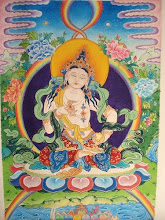
Thangka Artist: Ngakma Pema Zangmo
A-yé Khandro
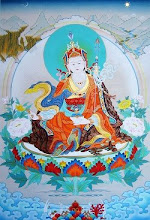
Artist: Anya Langmead
Prajnaparamita
Thangka Artist: Sashi Kumar
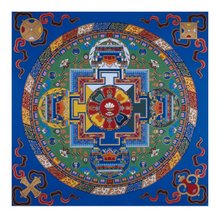
Vajrayogini Mandala
About the Author
In search of a new path, a 40-something with no previous art training heads to Kathmandu to study thangka at a Tibetan art school. Along the way he meets people, reads books, meditates, and writes about it here. Started in 2007, this chapter closes in 2009 when the author takes a teaching assignment in the UAE.
My Shikoku Pilgrimage Blog
Beginning is End
The end of building is ruin. The end of meeting is parting. The end of accumulation is dispersal. The end of birth is death. - Ken McLeod
"Twenty years from now, you will be more disappointed by the things that you didn't do than by the ones you did do. So throw off the bowlines. Sail away from the safe harbor. Catch the trade winds in your sails. Explore. Dream. Discover." - Mark Twain



 Posts
Posts