Showing posts with label Nepal. Show all posts

Wednesday, March 4, 2009

Appreciating what you don't have

On the way from a lecture about meditation, on the way to a yoga class, we passed through Central Department store. On this Sunday afternoon the displays of clothing, cosmetics and designer food were teeming with chattering people searching, inspecting, weighing, evaluating, hungry to fulfill cravings for beautiful things, to hold, to own, to possess, to smell, to taste, to be attractive, satisfied, satiated, that for a moment fear of impermanence, of decay and death, may be put aside.

Nepalis are only human and would not behave any differently if raised under the same conditions and given the same opportunities. Circumstances, though, have presented them with a different reality and at that moment I missed their simple ways, their ability to live free of modern marketing, the tyranny of over-abundance and the need to choose.

#

Saturday, February 28, 2009

Adjust again after initial failure

I have forgotten how the world works. The rest of the world outside Nepal and India.

For some reason when I checked in at the Kathmandu airport the Biman agent gave me a boarding pass for only the Kathmandu-Dhaka flight. By the time I realized I didn't have a pass for the Dhaka-Bangkok flight I was already through immigration, so I let the issue go until I arrived in Bangladesh. The layover there left me plenty of time.

When I stepped up to the transit desk in Dhaka and explained my problem, the agent asked for me by name. My boarding pass was ready and had been waiting for me. I was left momentarily speechless, but when my faculties returned I expressed as sincerely as I could my thanks for the attentive service I have received both times I have flown Biman.


In Nepal or India I suppose I might have had to spend a good part of my layover sorting out this kind of problem, but now here I found myself with two hours until my boarding call. I sauntered through the Dhaka airport, which both times I have visited has seemed exceptionally quiet and uninhabited. There was one customer in the restaurant, a few watching television, and no one in the shops. The local telecom agent has provided computer stands and free internet access, but no one was using them. Except me, of course. I had thought of doing the same in the Kathmandu airport, but didn't feel like paying the $2.00 fee just to write a couple of emails.


To Biman's credit, both flights departed and arrived on schedule. The only cock-up was in not having enough vegetarian meals on the Dhaka-Bangkok leg. There was the most minimal of queuing at the Bangkok immigration counter, the bags arrived within 10 minutes of getting through immigration, and as always customs in Bangkok was a breeze – no forms to fill out, no interviews, no spot checks. Just pick up your bags and go.


As I was walking through the airport to my hotel pick-up spot, I noticed a counter selling mobile phone SIMs and stopped to inquire. Only 199bht, about US$5.00, for a SIM and 100 minutes of local calls. I took out my phone and asked the girl at the counter if the SIM would work in my phone. By the time she answered “yes” she already had the SIM card in and activated. I was again left dumbfounded. I told her that in India it had taken me half a day to do what she just did in a less than a minute. She looked like she thought I might be pulling her leg.


The guy driving the hotel shuttle van was probably not in a hurry to do anything. He just liked to drive fast and the open roads at midnight gave him the opportunity, the fastest I have traveled over land in the last six months. It is simply impossible to move at such speeds over the potted streets and dirt roads of Nepal and India.


When I got to my room, I didn't have to ask if hot water was available. I didn't have to ask for a candle or inquire about when the electricity might go out. But when I finally got down to breakfast I did have to ask someone to help me sort out my mobile phone, which was not allowing me to make any calls, even to the provider's call center. I discovered in the booklet that came with my SIM that the provider did not include a contact number that can be reached from outside its network. My most immediate need, though, wasn't the SIM itself as it was contacting my friend Krit, who was going to come by and pick me up on the way to the airport to pick up Mutsumi as she arrives from Japan. The hotel had a land line for incoming calls, but not outgoing. So to call Krit to let him know I arrived safely and was waiting for his pick-up, I had to buy a phone card for one of the public phones installed in the lobby. Except that the hotel had sold out of domestic phone cards.

Now that's more like it, I thought. This is the kind of craziness I've gotten used to. Fortunately the girl at the front desk was kind enough to let me use her mobile to call Krit and I sorted out the problem with the SIM when we went back to the airport to pick-up Mutsumi.

The blog post comes from a dictionary entry, the photos from Wat Lat Krabang, located just across the canal from the hotel where I spent my first night outside Nepal/India.

#

Tuesday, February 24, 2009

Farewell to old friends . . .

. . . and old shoes. The guy downtown on Sunday insisted he could fix these for me. I know better than to argue with the touts but I was perhaps in a good mood. “I don't need them fixed because day after tomorrow I'm going to throw them away.” But I can fix them for you. “No you can't. Besides a torn heel there are wholes in the sole” I can fix that.

I realized then he wasn't interested in conversation.

So, here they are today, my last look after 11 years of service. I bought them when I first came to Nepal in 1998. They walked thousands of kilometers across this country and several others. Their last great journey was my walk around Shikoku last summer. Since then they've just been hanging on.


Back in December when the Iraqi reporter threw his shoes at George Bush, I thought about sending one each to George and Dick to congratulate them on their retirement, but that gesture has in only a few months become passe.

I feel like I should offer them to a ceremonial fire, but I suppose instead I'll just drop them in a garbage bag.

#

Monday, February 23, 2009

Meeting of the artists

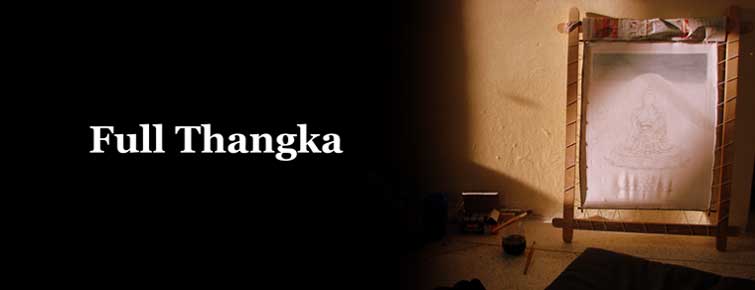
When I arrived back at my guest house after the wedding last Friday, I found a few friends in the dining room. I went in to show them my kurta, over which they oohed and ahhed, before they introduced me to a man in the dining room I hadn't yet met, someone who had that day just arrived from India. “This is Jeff,” they said to him. To me, “He's interested in thangka.”

Bart is a primary school teacher from Belgium on sabbatical and traveling across India and Nepal. He plays music and paints and has created his own thangka with a theme designed for his students. If you have a close look you'll see at the center of the painting the baby St Nickolas, who Bart described as perhaps the most important and powerful god of children. He is surrounded by toys, which he delivers to children at Christmas, and is protected by his guardian dogs and two black dragons.


Saturday we had a chance to take a photo together with our respective thangkas. Bart's leaving soon again for India to continue his travels through June. You can keep up with his adventures at Spiritual Eastern Journey.


#

Tuesday, February 17, 2009

Kathmandu Wedding

Since discovering Bollywood movies a decade ago, one enduring interest has been to attend one of those elaborate weddings so often depicted therein. They usually take place in palatial mansions with expansive grounds dotted with single-family-home-size tents erected to shade the hundreds, even thousands, of guests attired in finely embroidered silk saris and kurta. The wedding is an all day affair taken up with carefully staged and often mysterious religious rites, punctuated with helpings from lavish buffets, and ending with a choreographed dance party across much of the mansion and its manicured lawns and gardens. The Nepali Brahmin wedding I attended this past Friday wasn't quite up to these film standards, but from the real-life proceedings you could see the raw material out of which the filmmakers create their fantasies. It was more Monsoon Wedding than Kabhi Kushi Kabhi Gham.

As a guest of a guest of the groom's family, the morning began at the groom's home, where his friends and relatives assembled just before 08:30 to take tea to the straining, banging and blaring of the marching wedding band.


The official event probably began inside the home at the family altar. What most of us saw first was a procession of family members carrying sacred objects around an outdoor altar, a short visit to the temple next door to offer abbreviated prayers to the gods, and then circling the wedding car before the groom got in and the rest of us formed up in front.


With the band in the lead, we danced and strutted and walked through the immediate neighborhood, much like a New Orleans funeral procession, before climbing into a bus and being shuttled to a location a few hundred kilometers from the rented wedding hall, where we clambered out of our conveyance and resumed the noisy procession.


The bride's family was waiting for us at the wedding hall. There were so far as I could see no formal introductions. Over in one corner the bride and her family's priest were carrying out some of the required rites around a sacred fire, but most everyone seemed to be congregating around the tea and coffee bar.


Without announcement, the first of the day's ceremonies began on the stage set up at the end of the main hall. With the arrival of the bride and groom there was a mad rush for the stage, where everyone stood around craning, their sight blocked by the three to four photographers who throughout the day staked out the best vantage points.


After the ritual exchange of rings, garlands, and tikas, there were a number of mini-ceremonies within the larger ceremony, rituals done to insure a happy and healthy union, rituals that most of the guests and participants are as part of their cultural inheritance familiar with but rituals that most of them don't understand and can't explain. I was fortunate to be the guest of a young man whose father is a scholar of such things and who seemed happy to share his knowledge with a curious outsider.


I remarked to a fellow guest that if this were a Japanese wedding we would have started drinking nearly as soon as the event began. I was told that as these were Brahmin families alcohol was stickily prohibited and would not be permitted anywhere near the event. This turned out to be the policy for public consumption. Around noon I was approached and asked if I'd like a beer. I was led upstairs to a small room that was supplied with cases of alcoholic beverages and which was shortly visited by nearly every male guest. After a couple of glasses of beer I went down for lunch, and then a short nap on a sofa, and the next time I went upstairs I found the room cloudy with cigarette smoke and many of the same men still there playing cards.


They missed most of the afternoon's ceremonies, which took place around the ritual fire and concluded sometime around 16:00, about the time many people who had skipped out after lunch returned to see off the bride and groom. This was a more sober affair ending with tears as the bride's family watched their daughter get into the car with the groom's family and drive away. The band was again out in front as we paraded back down the street to the bus and the short drive home. This time we got off a few hundred meters from house and made an exceptionally slow procession home in order that someone might have time to sort out the problem with the generator, which had to be used as this area of Kathmandu was under black-out. It was imperative the bride not be welcomed into a dark home.

After being ceremonially welcomed, she and her husband were formally introduced to each member of the groom's family, who at this time presented the bride with a gift. Most of what I saw looked like jewelery boxes, most probably gold. The bride responded by presenting a token gift of money.


And then it was dinner time. By now it was close to 20:00 and I was offered a ride home by a family member in whose neighborhood I reside and who wasn't the least interested in an evening repast. Since public transport is fairly rare after dark, and taxis get harder to find as the hour gets later, I was happy to accept his offer, which probably turned out for the best and helped me avoid waking up in the middle of the night with indigestion. (I woke up instead from clogged sinuses caused by the spring pollen.)

w/ those who invited me: Reetu, Sagar, Sagar's father, and in front Neemish

This was no Bollywood wedding but was perhaps the most interesting cultural event I've attended in Nepal. It was certainly the longest and most elaborate and expensive. And for this I am indebted to my good friends, Sagar and Reetu. Thank you so much for making my last days here such memorable ones.

From today only 6 days left.
Saturday, January 31, 2009

I haven't yet tried either


I noticed this restaurant for the first time last week while waiting to use the ATM. Not only does it have something of an unusual name, but if you look closely you'll notice that it's located directly beneath a college of Chinese medicine.

I wouldn't be surprised if they have the same owner.

#

Sunday, January 25, 2009

Sweeping

Last Sunday morning as I was walking around the Stupa, I found this boy sweeping. I don't know if he was being paid to do this, or if he was doing it simply for something to do.

In either case, he was incredibly cute.


#

Saturday, January 17, 2009

Trouble connecting

The lack of electricity in Nepal has resulted in a number of unusual repercussions. Among them a weakening of the mobile phone network. As reported in the Himalaya Times this week:

Power Outage Causing Mobile Network Failure
Kathmandu, January 15

If your mobile phone is behaving erratically, this time don't blame Nepal Telecom (NT) only. Prolonged power cuts have created additional hazards in the mobile networks as BTS towers, the network providers, are not getting sufficient amount of charge. Of the 350 BTS towers in Kathmandu valley, some 22 BTS towers have stopped working due to the 16-hour load-shedding each day.

Complete article here.

And it's not just the mobile network, either. Mutsumi today sent me this translation of a notice appearing on the website of the Japanese embassy in Kathmandu. Apparently they've been having trouble with their landline.


Regarding the disconnection of the phone/fax lines

Our telephone and fax have been out of order. It looks like the intermediate distribution frame, which includes our line, was damaged when someone made a bonfire from a pile of rubbish to warm themselves.

Since it will take about a week to rebuild the destroyed system, please call the number below in case of emergency.


Bonfires in the winter are a common sight, even in the city, but I wonder if the fire that damaged the embassy's phone line wasn't meant to clear up some of the garbage that's been accumulating on city streets this week. The neighborhood that hosts Kathmandu's landfill has been protesting again and blocking the dumping of trash.


Villagers bar KMC from landfill site
Kathmandu, January 14

Kathmandu Municipal Corporation has not been able to collect garbage for the last few days due to a dispute between locals of two villages of Nuwakot and Dhading, on whose border the landfill site is located.

The collection was also hit after the locals of Chhatredeurali VDC in Dhading announced to bar trucks carrying garbage from entering the landfill site unless the government meets their 16-point demand.

Complete article here.


#

Wednesday, January 14, 2009

Load Shedding Schedule, Nepal, 11 January 2009


Last week the government announced new cut backs in electricity service, reducing hours of electric service from 12 to 8 hours per day. I live in the area represented by the first row in the schedule below (courtesy of Geshan Manandhar), a schedule that in listing the hours when power is not available doesn't quite give you a clear picture of day-to-day life. Assuming you sleep from 22:00 – 06:00 (which seems to be the case for most Nepalis, with an hour more or less on either side), the waking hours per week in which you would have electricity would be 38. Your electric-available times would look like this:

  • Sunday & Monday: 08:00-12:00, 20:00-22:00 (6 hours per day, 12 a week)
  • Tuesday & Wednesday: 12:00-16:00 (4 hours per day 8 a week)
  • Thursday-Saturday: 06:00-08:00, 16:00-20:00 (6 hours per day, 18 a week)

On Monday traffic was shut down in the city by students demonstrating against the new power schedule. The government blamed the lack of rain and the poor management of the previous government. Sales of generators, petrol and inverters are up. Everyone complains. Fortunately, I'm involved in an activity that doesn't require even a single watt of electricity, unless you care to paint after dark.

One positive development from all this: television stations have cut back hours of broadcast.

#

Tuesday, January 13, 2009

The road to Shechen . . .

... is being paved! Not with concrete, but still, it's a great improvement over the rubble. Thus far the work is taking place on the small stretch that begins at the fork where the road to the left leads to Shechen, the road to the right to the White Gompa.

These photos were taken while walking from Shechen toward the stupa.


Just before the turn-off, right in front of the tank where the women do their laundry, there is still a large hole from the water work that started and was completed back in November. You may remember it looked like this. Now it looks like this:


That building housing the restaurant was completely demolished to carry out the water work.
#

Sunday, January 4, 2009

The road to Kathmandu is neither straight nor smooth

It seems there's always a complication in returning to Kathmandu overland.

Many years ago on my first visit when returning from Pokhara the bus blew a tire just on the backside of the mountain facing the valley. Last year when making the trip from Lumbini demonstrators blocked the road demanding compensation for a slain family member and delaying our bus by six hours. Yesterday we had just crossed the mountains into the valley when traffic came to a stop. Just meters down the road a pedestrian had been fatally struck by an automobile. The police were on the scene but were entirely ineffective in getting traffic moving. After sitting on the bus for 30 minutes, most of us decided to walk to the other side of the accident and find alternate transport. We hiked about 15 minutes before finding a minibus into which we were pushed and jammed and squeezed to such a degree that it was impossible to make any movement outside of turning your neck or wiggling your fingers and toes. Fortunately, it was only 10 minutes to the bus park and a taxi home to the Dragon Guest House.

It's good to be back in Nepal.

#

Thursday, January 1, 2009

New load shedding schedule, 28 December 2008

As we open the new year I'd like to wish you all the best for a happy, healthy, and productive 2009.

For myself, I see I will have the opportunity on return to Kathmandu Saturday to practice a simple urban life-style. During my few weeks in India, the Nepali government has increased the hours of power outages twice, first to 10 hours daily in mid-December, and then again just a couple of days ago to 12 hours daily. Foretunately, electricity isn't much required to paint.


Leaving tomorrow for the Nepali border, planning to arrive back in Kathmandu Saturday afternoon.

Happy New Year.


#

Wednesday, December 3, 2008

New load shedding hours

The Nepal government announced its new load shedding schedule yesterday. Load shedding, for those of you who might not be able to guess, is a euphemism for power outage, the idea being that the power company, by turning off the juice, sheds the load on the system.

Beginning today, Nepal will be experiencing 7 hours a day, 6 days a week, without electricity. For those that might be interested, I live in Group 1.


Click on the photo for a larger view, or download the PDF file from the Himalayan Times.

And pass me a candle, will you?

#

Tuesday, December 2, 2008

Sunday in Shivapuri

Sunday was a lovely day outdoors, my first in some weeks, and a welcome change after nearly 10 days nursing a cold (which is mostly gone now, at last). My classmate Tsering put together a small party including me and two monastic classmates for a trip out to Sundarijal. There we visited the monastery where Tsering stayed when she first came to Nepal from India. We paid our respects to the 90-year old Rinpoche and were then joined by his care-taker, who acted as our guide on a walk through the low hills of Shivapuri National Park.


#

New application procedures for Indian visa in Nepal

If you've ever had to suffer through the hassle of applying for an Indian visa in Nepal, it might seem hard to believe the process has been improved. Having said that, its probably even harder to imagine it getting worse. The only way the Indians could have gone was up.

The bad news is that India hasn't yet caught up with the rest of the world and begun offering visas on arrival. They also continue to issue visas that are good from the day of issue, and not from the date of entry, which requires many people to have to wait for the last moment to make application. If you're fortunate enough to live in a culture in which efficiency is valued, then you may be able to mail your application, passport and fee to the embassy in your country and have it returned to you by post. If you're unfortunate enough to have to apply for one in Nepal, you'll have to set aside two days for queuing, plus an extra helping of patience.

In previous years applicants had to show up very early in the morning to get a number from the guards at the embassy gate. The earlier you got there, the lower your number, the better chance of getting served early (or at all). During the height of the tourist season, applicants would show up as early as 05:00 to secure a low number. Those more clever and willing to part with a little cash showed up the day before and bought a low number from one of the guards. The gate would open to admit applicants by number at around 08:30. Once on the embassy grounds, travelers then queued in front of the visa application window, which opened an hour later at 09:30, after which the jostling would begin, with people trying to cut in line and move their application ahead of the herd. The line would literally not move for 30 minutes at a time. It seems most applications were processed in the half hour run-up to the noon repast, when the embassy staff would rush to get everything done so that they could get off to lunch. For most applicants, this meant standing in line for 3.5 hours, from 8:30 until just before noon, plus spending 1.5 to 2 hours hanging around outside the gate.

This year the embassy has done away with the numbers at the gate, which means you have to arrive early and queue outside. Once the gates open, you file in by groups of 10 and after passing through security (past which you could easily smuggle weapons) there is now a computer with a touch-sensitive screen, with four buttons: tourist visa, transit visa, and two others related to other types of visas. When you press the tourist visa button, a new screen appears with two buttons: first visit (telex application), and second visit (visa application). Pressing the appropriate button returns a small slip of paper with a number.

When you get to the visa application counter you'll find that the embassy has installed digital sign-boards above the windows. When your number appears here, you can then approach the window and file your application. This makes the process a lot less stressful, as there is no scrum at the counter, you don't have to push past others to get to the window, and you don't have to worry about people jumping queue (so long as the staff is taking applications in order, which appeared to be the case this week). The embassy has also installed chairs in the area in front of the counter, so there is also no longer any need to choose between standing or sitting on the floor for up to three hours.

The hugely frustrating thing that hasn't yet been properly sorted out, though, is that you have to go through this process twice. The first day you apply only for a telex to be sent to the Indian embassy in your home country to inquire if you have been banned from travel in India. For this you must pay 300NPRs (approximately US$4.00). You are then asked to come back 4-5 days later, after the embassy in Nepal has received a reply to the telex inquiry, at which time you may then apply for a visa. Once submitted, you then return after 16:30 the same day to collect your passport.

A word of caution to those making their third or forth application for a tourist visa from Nepal. I met two people (one a Spaniard, the other of undetermined nationality) during my time on queue who had on a third application from Nepal had been denied 6-month visas. They were given 3-months and requested (probably more likely impolitely warned) to apply for future visas from their home countries. Another applicant, an Englishman who was not denied a visa, was called into an office and questioned about why he was making repeated tourist visa applications from Nepal. I also met a gentlemanly soldier from Afghanistan, a 21-year old who had been serving with the New Zealand peace-keeping forces and who was on his third visit to the embassy, having been twice refused a tourist visa without explanation. He was this day applying for a 15-day transit visa, which was again refused without explanation, despite having been promised one by the head of the visa section when his second tourist visa application had been refused.

It appears the embassy staff may be screening applicants more carefully, but by not informing the public of new policies and procedures it also appears to be acting capriciously. If there is any chance at all to do so, it may be better to apply in your home country and avoid unexpected outcomes in Nepal.

#

Sunday, November 16, 2008

Something pissy at the PO

Last Sunday I got a call from the post office informing me that a package had arrived and that I needed to bring a copy of my passport in order to pick it up. Why do they need a copy of my passport? And why don't they deliver?

The package was a small box of personal items – cookies, chocolate, some small gifts for a couple of my classmates – accompanying the main item, an updated credit card. Imagining I might need it next month in India, I had asked Mustsumi to forward it, and sweet person that she is she sent along an assortment of goodies via EMS, a kind-of courier service through cooperating international postal systems requiring signature on delivery. I had received a similar package last year, though it had been addressed to me at the art school and not my guest house. Since then Nepal has had a change of governments, so I suppose the rules for EMS may have changed as well.

I got there around 14:00 and after finding the EMS office was asked to step into a back room that must have been right next to the toilets and reeked of urine. While I was trying to imagine having to work in a such a place, the guy at the computer checking to verify I had received a package said I had not, then went back to munching on his apple, not at all concerned with me (or the smell of piss). When I reminded him that someone had called to tell me I had in fact received a package, a fellow in a topi said “come” and led me into a store room stacked with EMS packages, boxes and envelopes piled on shelves, on the floor, and on top of each other, in no discernible order (except perhaps that big, heavy ones went on the floor and not on the shelves). Topi asked where my package had been shipped from and made a desultory effort looking through the upper-most boxes before shrugging his shoulders and telling me that the package was not to be found. The computer guy came in looking for a package and pushed a box onto the floor to have a look at the one underneath. This seemed to be the one he wanted, which he proceeded with his feet to kick out the door. I started looking on a shelf on the opposite side of the room and Topi came and joined me and no less than half a minute later Mutsumi's package was in hand. But not for long.

I was sent to the EMS counter where a bored-looking young man in a baseball cap took my package and the copy of my passport and sent me to Room 31, just around the corner and smelling quite better than the back room of the EMS office. This was the customs office, staffed by six guys sitting around enjoying their afternoon tea. They didn't appear to be doing any work. In fact, they weren't. When I asked for their assistance, one middle-aged mustachioed guy pointed to the sign on the door, on which were posted office hours. Before I had a good look at it I thought I was being told it was now lunch break, or tea break. To my great dismay, however, I found that on Fridays work stops at 13:00.

I put on a face of dismay and kindly pleaded for help. The mustache didn't appear at all sympathetic, but the pro-wrestler with the red goatee was tilting his head (as Nepalis and Indians do to indicate something is ok, alright, acceptable) and telling him to go ahead and take care of me. A long form in triplicate with carbon paper in between was produced for which I had to pay 25 rupees. It was all in Nepali, so another guy at the desk told me which boxes to fill-in. After I signed it, I was sent back to 32, the EMS room.

Baseball Cap was still looking bored when I presented my paper from the customs office. He indicated I needed to wait. A few minutes later a guy showed up and indicated I should open my package for inspection. He had a quick look and didn't bother to ask about opening any of the envelopes inside. He started scribbling on my customs form, then took out a calculator, at which point I understood that I would be paying duty. I also understood why the Nepali PO doesn't deliver EMS packages.

Once he had signed off on the form, he gave one copy to me and sent me back to the customs office. There they took the form and recorded the relevant data, hand copying it to a large ledger book, before collecting 225 rupees. A copy of the customs form was returned to me, and I returned with it to the EMS office to at last collect my package, and to swear that anything else delivered to me here be sent by private courier, which in fact delivers straight to your door.

#

Sunday, November 9, 2008

Saturday in Thamel

I've been investigating post-graduate Buddhist Studies programs, not so much because I need another degree, but I thought as long as I'm doing all this reading in Buddhism anyway, and if it doesn't cost me too much, I might as well acquire social sanction for my studies. There's also the more practical purpose in Nepal of obtaining more permanent visa status.

The head of Tribhuvan University's Buddhist Studies department requested by email I meet him Saturday morning at Chhusyabaha, an old Newari temple in the center of Kathmandu. When I arrived just before 7:00 I was greeted by a man who was not Dr Vajracharya, but who pointed him out to me as the priest preparing to lead the morning puja.


I sat for a little more than an hour through chanting and a sermon, all in Nepali or Newari, I can't say which. Most of the chanting seemed fairly typical of what I've heard in other Buddhist traditions, though the 10-minute Om Mane Padme Hum mantra was unique, starting very low and building almost to a shout before returning to a quiet hum.


The professor/priest and I had a nice chat after the service about options for studying at TU, which I need now to follow up with more specific information on curriculum and instructors. In the meantime, my Italian housemate continues his efforts to convince me that the only program worth my consideration is the one he is currently enrolled in at KU.


After I left the temple I wandered around Thamel for a couple of hours, browsing in the bookstores, checking email, and walking alleys I'd never been down. I came across a street of butchers, who seemed at least for Saturday to be selling only boar. Or maybe that was the boar butcher's street.


Just beyond was a frame shop, which doubles as a merchant of religious iconography. Here we have quite an assortment of gods and gurus – Shiva, Pavarti and Ganesh, Kali, Buddha, Jesus, and Sai Baba.


I then wandered over to my favorite Nepali diner in Thamel, passing a Japanese restaurant along the way.


The walking about was largely to occupy time waiting for the noon start of the final day of the International Folk Music Festival. Several groups from different regions of Nepal, as well as artists from the Middle East and Europe were performing for four days in venues across the valley. Saturday was to see the artists together for a grand finale on the busiest street in the city's tourist quarter. The planners seemed to have envisioned the musicians and audience taking over the street, but that seemed not to have been planned and did not happen. Everyone was squeezed onto one side of the street, only a meter from passing traffic. One of the volunteers I spoke with said they were planning to shift to a nearby location that was better suited to the event. By then we'd already been standing in the street for an hour. It might take another to get things sorted. So I left happy to have heard a little and to have captured a few images.


#