Same questions. Can you guess the answers?
#

Apart from the obvious, like my name, can you imagine what the other answers might be?
The rules:
- Type your answer to each of the questions above into Flickr Search.
- Using only the first page, pick an image.
- Copy and paste each of the URLs for the images into fd’s mosaic maker.
#
 The film opens with a group of European tourists in Bodhgaya who come upon an elderly Indian devotee who relates the story of the great sage. What follows is a version of the life of the Buddha weighted toward his early life before leaving home, a time when he was known by his given name, Siddhartha. A few scenes featuring King Suddhodana and Queen Maya help establish the auspicious birth, while Siddhartha's childhood is skipped altogether (most likely to avoid the expense of an additional actor). The bulk of the story is given over to Siddhartha and Yasodhara's courtship
 and marriage, their life of leisure in a secluded palace, and Siddhartha's visit to town in which he is overcome by scenes of age, sickness and death. The six year search for truth is given short shrift. Siddhartha leaves home (his son Rahul is written out of the script) and walks a while, his family in a fever to locate and bring him back home, before sitting down to enlightenment. He is then seen preaching to a gathering of 20 to 30 people by a riverside, where he is found by his wife, Yasodhara, who then and there becomes his first disciple.
 For a film from this era, the acting is not as overdone as many. Siddhartha most often looks forlorn, his bride Yasodhara desperate (to be married) or distraught (with Siddartha's brooding and then his departure). Devadatta, thankfully, comes off as spiteful and advantageous, not a mustache-twirling villain. There is one cleverly staged scene wherein while Siddhartha talks with someone indoors, his wife passes by outdoors. Otherwise, the staging and camera work are fairly flat and static, not unusual for the silent period. Besides telling a story, this film served as well as something of a travelogue and so the viewer is treated to a number of long shots of temples, palaces, and street scenes.
 In Hindi “prem” is love; “sanyas” to renounce worldly life. The English title, “Light of Asia,” comes from English poet Edwin Arnold's epic poem on the life of the Buddha, first published in London in 1879, and in 1925 still one of the most extensive documents on the life of Buddha published in the English language. Arnold's subtitle for the work was, The Great Renunciation. English-trained Indian lawyer Himansu Rai apparently developed the script based on Arnold's work, which is itself based on a Hinayana Sanskrit text of the third century, the Lalitavistara.
Prem Sanyas was restored in 2001 by The British Film Institute and National Film and Television Archive. Picture quality is sharp and clean. Light blue, green, and sepia tint has been added to segments to add visual variety for modern audiences used to more color and movement. The orchestral score is surprisingly free of classical Indian elements and is perhaps more noticeable for the lack of voice and engaging characters and drama. According to the Spice website, two musical scores were written for German screenings, one by I. L. Fischer, the other by Hans-Heinrich Dransmann. No music credits appear in my copy of the film.
Director Franz Osten went on to make three more films in India, one of which, A Throw of the Dice, is currently available commercially. Prem Sanyas, unfortunately, is not, though a copy is in circulation among collectors.
Even with a release date of 1925, Prem Senyas is apparently the world's second film about the life of the Buddha. The first was the 1923 film, Buddhadev, from director Dhundiraj Govind Phalke, the father of Indian cinema. Buddhadev appears also to be out-of-print.
Release: 1925
#
 A collection of transcribed and edited talks given by Shunryu Suzuki, a prominent teacher in American Zen, the material here was delivered unscripted to students at intensive meditation retreats, marathon sitting sessions which cause a lot of physical and emotional discomfort for more than a few students. Not unsurprisingly, the themes of many of the talks are persistence, endurance, focus, and concentration.
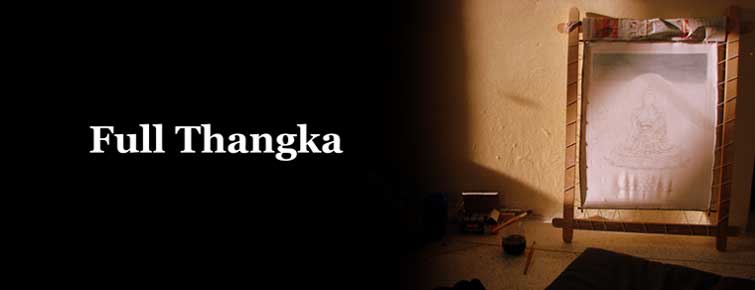
 Brazilian thangka artist Tiffani Rezende seems to have had much the same experience. Which may be why she titled her manuscript Life and Thangka, as it's the latter that gets most treatment in her self-published e-book. From her childhood in Brazil to traveling with her family in a caravan across Europe and Asia, Rezende presents material that would fit comfortably on a blog, personal anecdotes that only peripherally inform the brief sections on painting.
Through charm, sincerity, and web design skills, Rezende was able to secure a spot at the painting school of the Norbulingka Institute, an organization preserving and promoting traditional Tibetan arts from the seat of the Tibetan exile government of Dharamsala, India. When I checked with them in 2007 they were not accepting applications from non-Tibetans. Rezende's experience is another fine example of how we make our own opportunities by being in the right place at the right time – and simply asking.
Despite Life and Thangka's paucity of thangka-related text (perhaps 10 of 81 pages; the last 20 are poetry selections), Rezende's account does provide a glimpse of Norbulingka's painting program. Students apparently spend the first few months exclusively sketching with paper and pencil. Rezende's first subject was a Buddha head, followed two months later by a complete Buddha figure and then a complete Tara. Once her sketching skills improved, she began practicing painting, starting with background items such as flowers and clouds. After four months she was painting temple walls and shortly thereafter painting small background bits of commissioned thangka.
In contrast, at Tsering (where I've been studying) students spend the mornings drawing, the afternoons painting. Drawing practice is done with a wood stylus on an oil-and-chalk covered slate board. Every student begins sketching leaves, first titled right, then tilted left, then a right and left titled pair, before moving on to lotus flowers, clouds, fire, and then ritual objects such as conch shells and dharma chakra. Perhaps after 3-4 months they begin working on a Buddha head, followed by the Buddha's unclothed body, and finally the body with the complete set of robes. This is the entirety of the first year drawing practice. Painting practice is done entirely on paper. Students first sketch leaves, lotus flowers, and ritual objects, which they then use to practice techniques of dry shading, lining, wet shading, and triple shading.
I don't see any great advantage of one school's approach over the other, except that in so far as Norbulinka students begin doing authentic work in their first year it seems they might have a bit more motivation to practice, and practice more diligently. This seemed to be the case for Rezende, who found herself energized by the opportunity to do real painting in a real temple. I felt much the same myself after doing similar work, though it came at the end of my first year and wasn't a part of the school curriculum. If all you do is practice on your slate or sketch book, you begin to loose sight of your goal, like practicing scales but never playing a song, or practicing serves without playing a set of tennis.
Rezende concludes her story after having finished just over a year of study at Norbulingka and her first full thangka. While this first painting would normally be filed away in the school archives, most likely to never again see the light of day, Rezende's teacher allows her to keep hers. Reflecting on why a painting that took so much effort would be hidden away, the fledgling artist comes to realize the true purpose of thangka.
It became even clearer that to paint a Thangka is not always about the painting, but also the painter, who again doesn’t mean anything, because the painter is only another instrument of the art, like the brush, the paint, canvas and light. The illustrated manifestation of a deity or a mandala becomes free of any aggregate body of someone or something mundane attached to it. This is one of the reasons why a Thangka does not usually have the painter’s signature on it - just the blessed mantra ‘om ah hum’ for pure body, speech and mind, strategically placed on the back.
Rezenda maintains a website, mostly in Portuguese (with a bit of English), featuring a blog and gallery. She returned to Brazil in 2006 and has since been painting a new Buddhist temple in city of Viamão. Photos showing the progress of the painting can be viewed here.
A Portuguese version Life and Thangka, with additional material, will be issued soon from a Brazilian publisher.
Buy the English e-book at: http://www.lulu.com/content/157908
#
 I checked the indexes of a couple of Japanese histories, textbooks from my university Asian history courses, but there was no mention of Himeji. A day or two later I stopped by the library to see what I could learn; about the only reference I recall finding was in a Japanese geography text, which gave me a run down on population trends, industries and crafts, transportation, and other such data. Not really the kind of stuff to get you excited about your new home. Through an atlas I found Himeji located not too far from Osaka. Some days or weeks later someone at the Himeji board of education sent some tourist pamphlets, complete with photos of the castle and other areas of town, my first visual introduction to the city where I would live for the next five years. I was also given the postal addresses of the JET teachers then working in Himeji, with whom I was invited to communicate to learn what kind of things I might need to bring with me and how I might otherwise prepare for my new job and home.
 I promptly typed up a form letter on my new Macintosh SE, then made slight adjustments to personalize letters for each recipient. I printed these out and got them in the mail right away. It would take them at least a week to reach Japan, and assuming my correspondents were prompt, a week to receive a reply. I remember getting a couple letters in return, the unusual looking stamps on the thin-papered airmail envelopes. It was a relief to hear from other foreigners who were not only surviving but thriving in their work, reassurance that I would likewise do just fine, but in the time available we could exchange no more than two or three letters each.
This was all I learned about Himeji and my job in the few months I had before leaving for Japan. Even at an orientation session in Atlanta no one could tell me a thing about Himeji except that it had a very cool castle. I knew of only two or three people there, one of the them my boss, the others JET teachers like myself who had already been in Himeji for at least a year. I met all them through the post.
Which is typically how people over such distances used to meet and communicate. After arriving in Himeji with what was then considered a portable computer, a Mac SE with a handle built into the case, I designed semi-regular newsletters about my Japan experience for friends and family in the US. These I photocopied, folded, and stuffed in hand-written envelopes, which I would then deliver to the post office. A typical mailing cost around 3000-5000yen, depending on page count.
 My mother and a couple of other friends would on occasion send newspaper clippings of Atlanta happenings. National and international news was more easily available through the many English language dailies from Japan's newspaper publishers. In Himeji at that time there were no English-language television broadcasts, though there was in town on the main shopping street a Maruzen, a national bookstore chain carrying overpriced copies of imported newspapers, magazines, and books. The selection was, however, extremely thin, Himeji being a small city with not many foreigners. If you wanted a better (though hardly satisfactory) selection of books and magazines, you had to get on the train to Kobe or Osaka.
 One thing Himeji had plenty of were video shops renting VHS tapes. But much like the bookstores, the selection was limited, in this case to to the most recent Hollywood hits. There were very few films from countries outside Japan or the US, and you never saw row after row of shelves of multi-volume television series. In the early days after my move to Japan my father would send weekly video tapes of Monday Night Football and a new television series called Twin Peaks. Those tapes were a hot commodity at Shirasagi Residence, the gaijin ghetto of Himeji JET teachers. Being a huge Star Trek fan, and not wishing to impose on my parents, who might not understand the completist needs of a geek, I managed through letters to a fan magazine to contact a young female fan in the US who taped and sent me episodes of The Next Generation every five to six weeks. I covered costs through postal money orders and returned the favor through all manner of Japanese souvenirs.
Where the video selection was thin, the music choices were abundant. Rental shops carried everything from pop to rock to dance to jazz to soundtracks – before the RIAA and their political allies stepped in and convinced the government to prohibit the rental of most cds from foreign artists, leaving only the crappy J-Pop stuff on the shop shelves and forcing many store owners into other avenues of business.
At school we largely made our own teaching materials. As the JET programme was brand new, there was no materials-bank to speak of. The Board of Education didn't know much more than their teachers about how to get their students to use English to communicate. In fact they would ask the newly arrived JET teachers to help instruct their teacher training programs! On rare occasions we made do with copies of handouts left by the previous year's teachers, but for the most part we made it up as we went along, sometimes in collaboration with the Japanese English teachers, sometimes not, until three years later we could leave the programme with a folder of self-created materials and lesson plans and some idea about how to conduct classes.
When vacation time came around and we decided we might like to travel abroad, first call was to the embassy of the country you wanted to visit to see if they might have tourist information they could send by post. Countries with national tourist boards, such as Singapore, Hong Kong, or Thailand, used to do this kind of thing. You might ask around among your friends to see if anyone had a guidebook to Thailand or Indonesia, otherwise you'd end up taking the train to Kobe or Osaka to visit the bookstore for the latest Lonely Planet, or perhaps the office of a travel agent who had experience with overseas travel. The only up-to-date information about the country was the political and economic news you might come across in mass media sources. Finding out about new hotels, restaurants and the like required contact with an agent in-country, or waiting until you got there.
Twenty years is such a short time. But it seems it might as well be a different age.
 Today if you're going overseas to work you can do an amazing amount of research right from your home computer. You can see pictures and video of the place you are going to live, join forums and discussions with people living there, read the latest news from the country, order specialized books about the city and culture. There is very little you cannot learn before you set foot in your new home. Once you're there, you can easily communicate with friends and family back home, keep up on all the latest news, and download or have sent to you any book, movie, television show or music you might possibly desire. In your work, you can access a worldwide store of resources, and consult with experts as far away as the other side of the globe.
It sometimes seems that living in another country has become too easy, that much of the thrill of the unknown has been removed. The generation before mine must have said something similar. Imagine when going to live in Japan meant taking a ship across the Pacific, when there was no possibility of phoning home, when there were no books or magazines or movies that were not in Japanese. Sometimes I wish I could have come to Japan during that age, when an overseas adventure meant leaving everything familiar.
#
 Many years ago it was not uncommon, and sometimes altogether too frequent, for Japanese children to lob verbal grenades at foreigners passing in the street. The most commonly used form of ammunition was a overtly enthusiastic “HAROH!” If you were walking about unaware of the presence of children, you could easily be startled. Adults were a little more circumspect (unless inebriated) and you couldn't always hear what was being whispered, though usually you'd catch a whiff of “gaijin” or “amerikajin.”
 Kids don't do that much anymore, and neither do adults. I suppose that kind of behavior might still be in evidence in pockets of rural isolation, but in the cities Japanese have become fairly used to the presence of foreigners. To a great degree, we are no longer novel.
There are probably more than a few reasons for this that I won't touch on here, but one of them surely has to do with the Japan Exchange and Teaching Programme, a government run scheme that has for the past 21 years brought young, college educated native speakers of mostly English (though in more recent years of other languages, as well) to serve as language teaching assistants in the nation's public school system. I came to Japan on the second year of the program and was on the government payroll for three years in the junior high schools of Himeji. In those early years there were fewer than 1000 JETs; now there are over 5000. And thanks to this program, today nearly every Taro, Junko, Hiroshi and Ikemi in Japan, though they may never have left the archipelago, has met and interacted with a genuine, air-breathing, hand-shaking gaijin.
 There's also the fact that many Japanese have now been overseas themselves. It used to be not too many people could afford it because the only way to go was on overpriced package tours, traveling around in a protective bubble of Japanese culture, never having much interaction with non-Japanese beyond the cashier ringing up souvenir purchases. But with the introduction of discount airline tickets and more especially the accumulation of knowledge brought back by the first waves of independent travelers, more and more Japanese began to see it was possible to travel by learning to plan and manage for themselves. Today one of the most commonly cited reasons for studying English at language schools or even at university is for travel.
An incident last week is indicative of how things have changed. I was in the elevator of a department store with a young boy of maybe eight or nine, and he struck up a conversation with me. In Japanese, of course. The JET programme and foreign travel haven't much raised the level of English fluency among Japanese, but they have made them more comfortable around foreigners.
#
 It's hard to find a young lady today who hasn't been manicured, pedicured, and coifed. 20 years ago the women I knew found it far too daring to apply more than a light pink to their fingernails, an unremarkable skin tone that could easily go unnoticed. Only punks had their hair dyed – or their bodies pierced. The most common type of earrings were clips. Mutsumi, for example, didn't have her ears pierced until she was in her 20's. Today you'll see youngsters of both sexes with an ear-full of piercings, some also with body piercings, and more than a few bold enough as to have tattoos, formerly the decoration of only gangsters and punks.
 It's still not as common as in Europe or North America, but recently we've begun to see more young couples making public displays of affection, the most common being an arm around the shoulder or holding hands. 20 years ago couples of any age would have been too ashamed to do even this.
 Sorely missed by the immigrant community in Japan is sodaigomi day. Many a foreigner's apartment was furnished by the leavings and discards put out on the street for collection on big garbage day. Good stuff, too, not just banged-up trash – functioning televisions, stereos, bookcases, tables, dressers, bicycles, books, records. For the foreigners sodaigomi day was shopping night. Sometimes if we found something good we didn't need but knew someone else could use, we'd phone them up and let them know where to find it. It used to be a lot of fun, like a free monthly flea-market. But then the politicians got the idea that citizens should pay for disposal of each item of trash and the city switched a few years ago to a collection-on-demand system and sodaigomi day was no more. Credit the city, though, with taking a more rational approach to garbage collection in general. It used to be we put out only two kinds of trash, burnable and non-burnable. Today we still have those categories, but the city now also collects pet bottles and glass separately, while private initiatives in our area collect cardboard, newspaper, clothing, and aluminum.

It's so much easier now as a foreigner to get in and out of the country. This used to require a visit the immigration office every time you wanted to leave in order to get secure a reentry permit, a little stamp in your passport allowing you to renter on your current visa. The permit is completely unnecessary; it's nothing but a tax on foreigners. You still have to pay it, but now you can get a multiple-reentry permit that allows unlimited returns for up to three years.
 Used to be when you did get back, you then had to stand in line at the immigration counter with all the tourists. Today foreigners with reentry permits can use the counters for citizens, which still causes some confusion among the locals who don't travel much. More than once I've been directed to the line for tourists by a well-meaning Japanese who hasn't carefully read the sign above the immigration counter.
#
 ATMs have been around for a while, but it's only within the last few years that 24-hour service has become available. When I first got here, the machines operated only weekdays 09:00-18:00. The banks imagined they were providing a service by making ATMs available after their ridiculously inconvenient closing time of 15:00. Today 24-hour ATMs are conveniently located - in convenience stores.
 It's possible now in most urban shops and restaurants to make purchases with credit cards. Even foreign-issued credit cards. 20 years ago department stores found it inconvenient, or impossible, to accept plastic payment, especially if your card hadn't been issued in Japan.
 We don't drive and so don't know much about how car or driving culture has changed over the past two decades. One noticeable difference though is that you can now pump your own gas. Until a few years ago, all gasoline stations were full-service.
 When I arrived in Himeji 20 years ago we had only five channels of terrestrial broadcasting. I haven't been back to Himeji in a while, but I guess they have the same options now as the rest of us, a plethora of television channels broadcasting all manner of crappy entertainment, both through cable and satellite.
 I was thrilled to find a Tower Records in Himeji and equally surprised to find that all they sold were cds. Vinyl was still a viable format in the US in 1988, the year when cd sales first surpassed vinyl. But as is often the case in Japan, the producer determines what gets to market, and the record companies had already switched to digital. Today record stores are dying.
 One thing that hasn't changed much is the cost of a movie ticket, probably one of the most overpriced items in Japan besides rice. It seems tickets were perhaps a bit less expensive when I got here, but this article from 1988 suggests not by much . The current cost is 1800yen for a walk-up ticket, though they can be had for 1300 through advance purchase. While prices may not have changed much, the movie going experience has. When I got here the theaters I visited seemed to have been constructed in the 1950s. Seats were narrow and threadbare, floors were sticky, the rooms had a funky odor from the accumulated tar and nicotine, smokers could still light up during the film. Concessions consisted of vending machine beverages and bags of chips, senbei, and dried squid. It's like they didn't care. They didn't have to. The theaters were all equally decrepit. Then AMC showed up in Fukuoka, where they built the first multi-screen cinema in urban Japan. Once they opened their doors, Japanese found clean facilities, comfortable stadium style seating, and a much wider range of concessions. The old theaters started losing business and either closed up or remodeled to compete with AMC (whose business in Japan has since been bought out by the European owned United Cinemas). Now if we could only get reasonable ticket prices.
#

 Posts
All Comments
Posts
All Comments