Tuesday, August 19, 2008

1988

1988 began in the Soviet Union with Mikhail Gorbachev launching his Perestroika economic reforms at home and abroad withdrawing troops from Afghanistan. The US Congress denied the Regan administration funding for its terrorist campaign against Nicaragua, and one of the key players in illegal arm sales to Iran, George Bush senior, became a nominee for the fall presidential election. The US Navy shot down an Iranian civilian airliner in the Persian Gulf, while Pakistani generalismo Muhammad Zia-ul-Haq and the US ambassador to Pakistan died in a mysterious plane accident.

European and American companies were trying to figure out how to emulate Japan's success, a country riding high on a skyrocketing stock market and land speculation boom. From the scrum of greed emerged an insider trading deal known as the Recruit Scandal, forcing a number of prominent Japanese politicians into retirement. The Showa Tenno (Emperor Hirohito) continued his state duties with only months to live.

And I arrived in Japan.

I don't remember the date, though it's probably noted somewhere in a stack of old letters in a box in an Atlanta attic. I remember my first festival in Japan was an evening bonfire by the riverside to welcome the ancestral spirits home for the Obon holidays. I spent about a week in Tokyo before being shipped off to my job and home in Himeji, so I had to have arrived late July or early August.

Before leaving the US my mother said I'd be ready to come home after a year. I thought I might like to stay at least two or three.

This summer marks 20 years. 240 months. 7300 days.

A lot of things have changed in the interim.

#

Monday, August 18, 2008

Movie Review: The Man From Earth; Richard Schenkman, dir; 2007

The Man from Earth has achieved something of cult status among, well, I'm not sure whom. This is not a film that would appear to appeal to any easily imaginable cult-like demographic. Classic Star Trek fans showed some interest, as the film's writer also scripted a couple of episodes back in the 1960's. After the film flopped commercially, it got a new lease on life through P2P networks; the director even issued a statement thanking file sharers for helping rescue the film from obscurity.

After watching it, you might wish it had never been rescued.

At a farewell party for one of their colleagues, a group of academics learn that the departing professor is 14,000 years old. They sit around and talk about this for an hour and a half, about the places he's been, the people he's seen, the things he's done. The acting is dreadful, as you might expect from a cast that performs mostly in local theater or as television extras, and the script something that might have been penned by a first-time writer. The dialog is lifeless and humorless, and the surprise endings are silly contrivances like those in old episodes of the Twilight Zone, the ones you thought were cool when you were twelve years old but which now seem hopelessly trite.

This is a movie that deserved its obscurity.

#

Movie Review: Light at The Edge of The World: Science of the Mind (2007), Wade Davis

Another western student of Tibetan Buddhism wanders into Nepal and is overwhelmed by the majesty of the mountains and intoxicated by the perfume of incense, chanting, temples, paintings and statuary. Canadian anthropologist Wade Davis quite clearly believes in the power of Buddhist practice to liberate the mind from illusion and suffering. He speaks about it passionately and eloquently and includes in his presentation more than one scene of himself succumbing to tears during teachings and meditation. But he seems to forget his purpose, to help a western audience understand that this practice has some basis in science. This chapter is, after all, entitled “Science of the Mind,” one of four chapters in “Light at The Edge of The World,” a National Geographic series exploring endangered indigenous cultures.

Wade interviews a nun who has been in solitary retreat for some 40 years, a mountain hermit who sits daily meditation and chants a single mantra, Om Mani Padme Hum. No doubt this is quite an impressive feat, sitting up there alone for four decades, but in presenting her practice as something benefiting all sentient beings, the question that comes to mind is - how is sitting on a mountain chanting more helpful than getting down into society and getting your hands dirty dealing with the day-to-day needs of the poor of Nepal? In what measurable way does her practice help anyone but herself?

Wade claims that the enlightened nature of people such as this nun or his teacher, Venerable Trulshik Rinpoche, is the empirical evidence attesting to the efficacy of the Buddhist practice. But what does it mean to be enlightened? What are the necessary conditions? How do we measure it? What is it that allows us to say this person is and this person isn't? We know that people from other cultures, some practicing other traditions, some practicing none, exhibit this kind of enlightened personality. Wade himself notes the proverbial 84,000 paths available to Buddhists, but doesn't question whether some are more effective than others in producing these enlightened states of mind. Perhaps it not Buddhism at all, but simply being on a spiritual path, opening oneself to new ways of seeing and experiencing.

But assuming that Tibetan Buddhism is one of many roads leading to a state of enlightenment, we never learn how one gets there, what specific practices are included in “the practice.” We can see in the film that chanting, praying, and meditation are involved, but no course is explicated. There's one scene where Davis shows French translator, author, and practitioner Matthieu Ricard wired for a laboratory experiment on mediation. We're told the results showed altered brain states, but beyond that it's up to us to imagine what might have been revealed. That's about as close as Davis gets to presenting the science of the mind.


“Science of the Mind" can currently be viewed in its entirety at YouTube.

#

Tara for Mutsumi

Yesterday was Mutsumi's birthday. We had a nice day and Mutsumi got some nice presents, including this Tara I drew for her. (Click the image for a larger view.)


#

Sunday, August 17, 2008

Movie Review: Naked in Ashes (2006)

Beautiful footage, empty film

Naked in Ashes is a good dessert, loads of tasty sugar with little nutritional value.

Filmmaker Paula Fouce presents amazing documentary footage of India's yogis, loin-clothed mystics roaming the countryside in search of God and enlightenment. If you ever thought your yoga workout at the suburban studio was tough, try standing for 12 years, or holding your hand above your head for 30. If that's too extreme, you might try walking around naked smeared in ash, sitting meditation with a plate of raging fire on your head, or maybe pulling a car with your genitalia. These guys are dead serious.


Fouce, though, seems anything but, at least for the viewer who is not already a committed Hindu. The yogis talk quite a lot about God, the soul, enlightenment, and ultimate reality, but these statements amount to little more than a collection of non sequiturs. Nothing adds up.

A number of questions are left unasked. Where are the yoginis, the female practitioners? How many of these yogis are imposters? How many become yogis simply because they've become addicted to the marijuana high, or to escape social and familial obligations? How many give up the life after a short time?

Watch this like you might a slideshow, for the beautiful imagery. Don't expect to learn much.


  • Directors: Paula Fouce
  • Studio: Paradise Filmworks International
  • DVD Release Date: November 2006
  • Run Time: 103 minutes

#

Thursday, August 14, 2008

A Yankee in Ladakh

A New York accent in Nepal is not only not noticeable, it's kind of hard to ignore, especially when that voice belongs to such a kind-hearted traveler. It was my great pleasure last year to meet William, an even older fart than me who has since gone on to travel all across the Himalayas, from Sikkim across to Ladakh. Along the way he's taken some lovely photographs, most recently from the Phugtal Monastery in the Zanskar region of Ladakh.


If you would enjoy relaxing for a few moments with some more stunning imagery, you might like to click here and launch a slideshow. If you are so moved, send William a message and express your appreciation for sharing his work. His email is on the front page of his website.

#

Just call me Graybeard

This past Sunday I went to a Salsa festival that was to everyone's great regret rained out. While we attendees were huddled under a shelter waiting for the rain to end (and the festivities to restart), a young Japanese man noted that I was a cool-looking old guy. He wished Japanese old guys were as cool, but, hey, look around here, he said waving his arm over the group. There aren't even any old Japanese guys here.

Then two days ago I was chatting with a Canadian guy I met through the internet. Something he said reminded me of the Czech Brothers. Which brothers, he asked? So I sent him a youtube link to one of the Steve Martin and Dan Akroyd sketches from the 70's. Man, the Canadian guy said once he'd had a look at the video, you are old.

It seems not only has youth passed me by, so has middle age.

#

Monday, August 11, 2008

Tara drawings

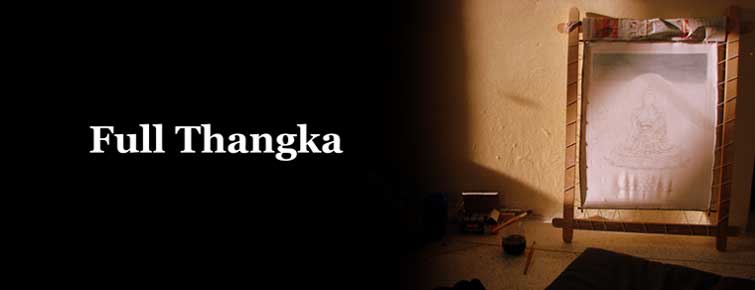
So, besides watching movies and reading books, just what am I doing, you might wonder. Here's a partial answer, a little practice on Green Tara, who actually isn't green yet, just some pencil lines on paper.

Did a few heads...


Then a body without robes . . .


And then took off in another direction . . .


I'm working now on a Tara with all the robes. I hope to finish this week. Stay tuned.

#

Sunday, August 10, 2008

Movie Review: The Unwinking Gaze (2008), Joshua Dugdale, dir


Clothes Don't Make the Man


The Unwinking Gaze
is perhaps the most honest and genuine film about the Dalai Lama likely to be released in his lifetime. Using a simple documentary style eschewing voice-overs to let the actors speak for themselves, the filmmaker presents the highlights of three years worth of film with a focus on the exiled Tibetan leader's political life. What stands revealed is a principled but human figure struggling to stand firm against tides of ignorance, fear and hate.

While the title refers to the subject's determination in the face of Chinese prevarication and provocation, it might also refer to the filmmaker's resoluteness in exposing the Dalai Lama. According to director Joshua Dugdale, a former BBC producer, the film was conceived as a political tool, a chance to show to Chinese decision makers, and to the Chinese public, the unfiltered, unedited Dalai Lama, to show that there is no “clique” intent on “splitting the motherland,” only a deeply spiritual man trying to carve out some space in the Chinese People's Republic for the preservation and growth of Tibetan culture.


For a little over an hour the camera follows the Dalai Lama as he meets with world leaders, is debriefed by envoys returned from meetings with the Chinese government, speaks to a large public audience in Canada, tours Bodhgaya, and greets Tibetan refugees newly arrived in the Dalai Lama's exile home of Dharamsala, India. Along the way, when opportunity permits, Dugdale intercedes with questions. Do you ever have any doubt? Never, says the Dalai Lama. None. Will you ever change your position against the use of violence in the struggle for Tibetan freedom? He again answers never. His adamance is something of a surprise from from a leader of a spiritual tradition in which practitioners are encouraged to give up attachment, attachment to things as well as to ideas. The Dalai Lama, it appears, still has a few of his own, a stubborn old man who in his unwinking implacability comes across all the more lovable, all the more deeply human. Asked what it means to be a monk, he answers that as long as one aspires to practice spirituality sincerely, being a monk is nothing more than a matter of changing clothes.

  • Director: Joshua Dugdale
  • Studio: World In Vision
  • DVD Release Date: June 18, 2008
  • Run Time: 70 minutes


Official website
Dugdale at TimesOnline
Interview with Dugdale (opens as pdf)
Amazon

#

Thursday, August 7, 2008

Movie review: The Story of India (2007)

A Story Worth Watching

The Story of India is an informative and visually beautiful document from one of the UK's most popular historians. Comprised of six one-hour chapters, it is not the whole story of India, nor is it perhaps the best story of India. But anyone coming to this series wanting to learn something about the world's most ancient culture will find many treasures here.

Michael Wood attempts to cover the major events and trends of Indian history beginning with the migration of Africans into India 70,000 years ago, and ending with Independence in 1947. He impresses as someone deeply knowledgeable and passionate about his subject, and erudite in explaining it. Unfortunately the story often unwinds as Wood chases down bits of arcania of interest only to amateur historians and archaeologists, and on occasion the production wanders far afield for what Wood and his producer may have supposed might be attractive footage, such as the presenter riding in a tank in Iraq.


Some of the most interesting moments of the series are in the bonus material, unscripted footage of interactions between the camera crew and Indians that give an immediate sense of life on the subcontinent. It's too bad more such scenes could not have been included, and a lot of the historical trivia left out.


Amazon
Wiki episode descriptions
BBC Official site


#